
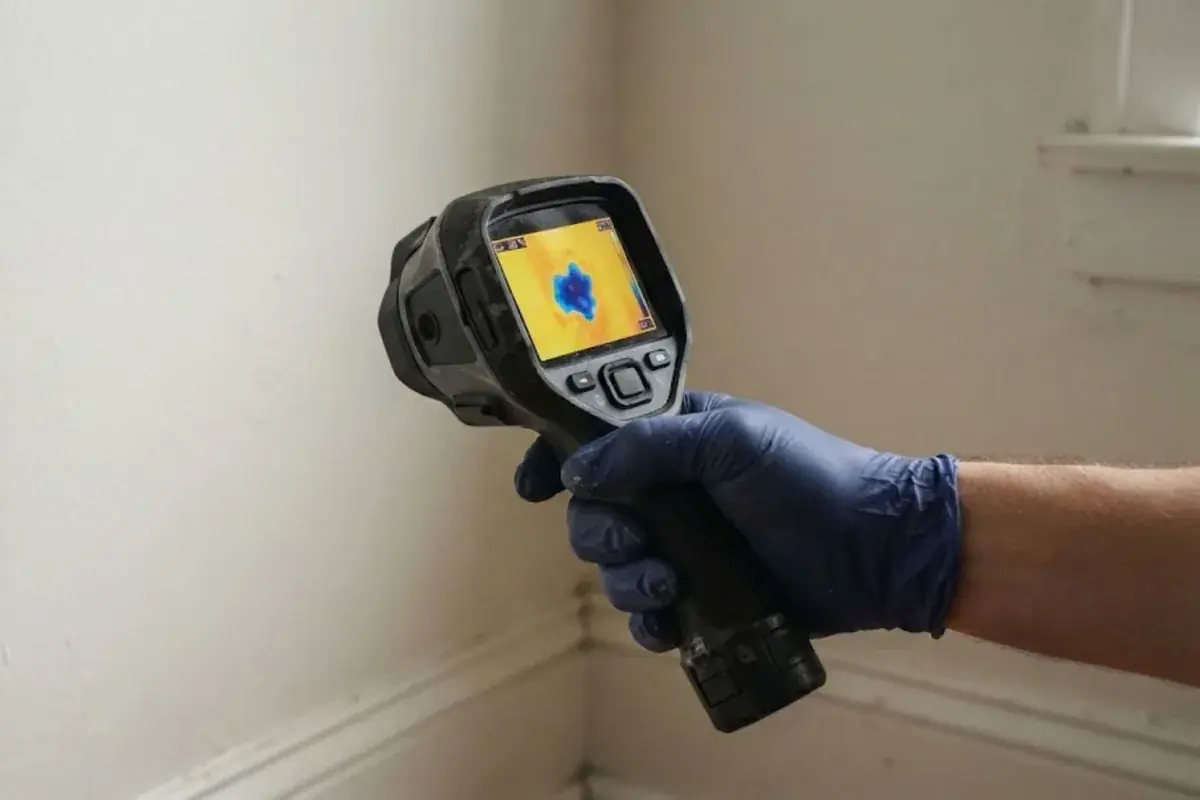
Infrared leak detection uses a thermal camera to show surface temperature differences. When water leaks inside a wall, a ceiling or a floor, the wet area is often a different temperature from the dry area around it, and the camera turns that difference into a picture. It is a useful tool, and it is also one of the most oversold ones.
This guide explains what a thermal camera can really show a plumber, where it falls short, and why a good leak search almost always uses more than one method. If you are trying to decide whether to pay for a leak search, it should help you ask better questions.
What an infrared camera actually sees
A thermal camera does not see through walls and it does not see water. It sees the temperature of the surface it is pointed at. A damp patch of drywall cools as the water evaporates, and a hot water line behind a wall can warm the surface in front of it. The camera shows those patterns, and an experienced operator interprets them.
That makes it good at a few jobs. It can narrow down where to look on a large ceiling stain, trace the path of a hot water line or a radiant heating loop, and show a wet area without opening anything. It is a way to decide where to cut, not proof that a leak exists.
Where thermal imaging falls short
- Cold water leaks inside a wall that is already cool may show little or no contrast.
- A leak that has stopped can leave a damp area that looks the same as an active one.
- Condensation on a pipe, a sweating wall or a cold air duct can look like a leak.
- Insulation, thick finishes and metal can hide temperature differences.
- Anyone can buy a camera, but reading the picture takes training and context.
Because of these limits, a thermal image alone should not be the reason to cut into a wall or a slab. A responsible plumber confirms what the camera suggests with another method before any demolition begins. If a company offers to open a wall based only on a heat picture, ask what second method confirmed it.
The other tools in a real leak search
| Method | What it does | Good for |
|---|---|---|
| Water meter test | Shows whether water is moving when every fixture is off | Confirming that a leak exists at all |
| Pressure test | Isolates sections of a line to see if they hold pressure | Narrowing a supply leak to a section |
| Acoustic listening | Picks up the sound of water escaping from a pressurized pipe | Pinpointing leaks under floors and slabs |
| Moisture meter | Reads moisture inside a material | Checking walls and floors the camera flagged |
| Thermal camera | Shows surface temperature patterns | Guiding where to measure, especially for hot lines |
| Camera in a drain | Looks inside drain and sewer pipes | Leaks on the waste side |
The sequence matters. A meter test comes first, since there is no point searching for a leak that is not there. Then the plumber isolates the system, listens, measures and only then uses the thermal camera to place the cut. Our leak detection page describes how that works in practice, and the slab leak repair page covers leaks under concrete.
Signs you may have a hidden leak
The most reliable sign is a water meter that keeps moving when every fixture in the house is off. Other signs are a water bill that rose for no reason, the sound of running water in a quiet house, warm spots on a floor, a musty smell or a stain that grows. Any of these is worth a call, and a growing stain is worth one soon.
Do your own meter check before you call. Turn off everything that uses water, find the meter, and watch the small low-flow indicator for a minute or two. If it moves, there is water going somewhere. Tell dispatch what you saw, since it helps the plumber bring the right tools.
Questions to ask a leak detection company
- What methods do you use, and in what order.
- Will you confirm the location with a second method before cutting.
- What happens to the cost if the leak is not found.
- Will you give me a written description of what you found and where.
- Who repairs the leak and the wall or floor afterward.
What happens after the leak is found
Finding the leak is only half the job. The repair depends on where it is and what it is made of. A leak in an accessible pipe is a quick fix. A leak in a wall means opening the wall at the spot the tools identified and then closing it again.
A leak under a slab can be repaired by rerouting the line, by replacing the section from above or by repiping, depending on the condition of the rest of the pipe.
Ask for a written note of what was found, the location and the method used to confirm it. That document helps if you file an insurance claim, and many insurers ask for evidence of the cause and the date of repair. Keep the photographs, too. Water damage that is dried quickly is a smaller problem than damage that sits, so tell your insurer early and ask what they require.
If the leak was one of several, the plumber may suggest a pressure test of the rest of the system. Pipes tend to fail where they are oldest, and a second leak close behind the first is not unusual.
Standards and honest claims
There is no code that requires a thermal camera, and manufacturer guidelines for the camera itself say it reads surface temperature. Repairs after a leak is found are held to the California Plumbing Code, which is built on the Uniform Plumbing Code (UPC).
Hidden leaks in the area
Rohnert Park's housing dates from the planned development of 1956 and 1957 onward, and homes from those first decades are now old enough that supply and drain lines are worth checking when a bill climbs. The City publishes an annual water quality report, and you can ask the Public Works line at 707-588-3300 about service on your street before you assume the leak is yours.
Wherever the meter sits far from the house, a slow leak can hide for a long time. See Penngrove and Cotati for other nearby service areas.
Source: City of Rohnert Park Public Works.
Questions readers ask
Can an infrared camera find a leak by itself?
Not reliably. It shows temperature patterns, which can point to a leak but can also be caused by condensation or an old stain. A second method should confirm the location before anyone cuts.
How do I know if I have a hidden water leak?
Check whether your water meter moves with every fixture off. A moving meter, an unexplained bill increase or the sound of running water points to a leak.
Should I call the City if my water pressure drops?
It is a reasonable first call. The City of Rohnert Park Public Works line is 707-588-3300, and they can tell you whether there is work on the street before you hire a plumber.
Do you offer leak detection on nights and weekends?
Yes, for active leaks. The line is open 24/7, and a leak that is flooding a room should not wait.