
Water heater installation is a planned job: a new home, a remodel, a switch from tank to tankless or an upgrade you want done before the old unit fails. The calendar is yours to pick, though we offer same-day visits when the schedule allows. If your tank has already failed, emergency replacement is the faster route.
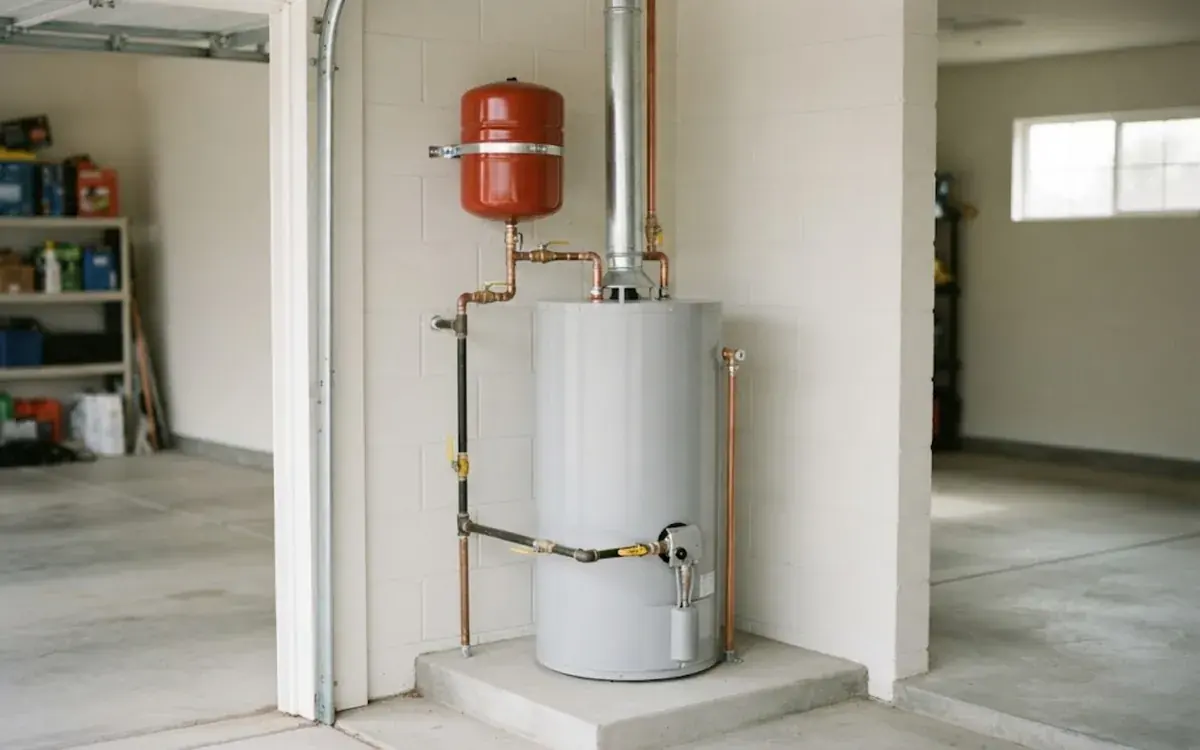
A correct installation is more than connecting pipes. The venting, gas supply, relief valve, drain, expansion control and bracing all affect safety and how long the heater lasts.
Planning the install
Start with the household. Count the people, the bathrooms and whether a soaking tub or two showers run at the same time. Those numbers set the capacity. Then look at where the heater sits. Garages, closets and attics each bring different clearance, venting and drain requirements.
| Question | Why it matters |
|---|---|
| Gas or electric? | Decides the venting, supply line and whether a new circuit is needed. |
| Where will it sit? | Clearances, floor drain and access shape the install. |
| Is there a closed system? | A closed plumbing system needs an expansion tank to absorb heat-driven pressure. |
| Tank, tankless or heat pump? | Each has a different cost, footprint and set of site requirements. |
Expansion tanks and relief valves
When water heats, it expands. In a closed plumbing system, with a check valve or pressure reducing valve on the supply, that extra volume has nowhere to go, so pressure rises. An expansion tank gives it a place to go, and the relief valve is the last line of defense. A relief valve that drips regularly is a clue that the system lacks one or that the tank has failed.
Bracing, venting and permits
California is earthquake country, so ask about seismic bracing at every install. Gas heaters must vent combustion gases safely outdoors, and the vent route is often what decides whether a straight swap is possible. For permits, the City of Rohnert Park Building Division at 707-588-2226 can tell you what applies to your address. It lists only a licensed California contractor or the legal property owner as eligible for building permits.
We follow the California Plumbing Code, which is built on the Uniform Plumbing Code, and the NEC for electrical connections. Tankless installs bring their own requirements for gas line size and venting, and our tankless page covers them.
New construction and remodels
Builders and remodelers in Rohnert Park often need heater rough-in and trim at different stages. We coordinate with the schedule, set gas and water stubs where the heater will sit and return for the final connection. If you are redoing a bathroom or kitchen, see plumbing installation for how the water heater fits into the larger job.
What to have ready before the plumber arrives
A short list helps the visit go faster. Photograph the data label on the old heater, since the model and capacity tell the plumber what fits. Clear a path to the heater and a few feet of floor around it, and know where the main water shutoff and the gas shutoff are. If the heater sits in a garage or closet, move stored items away from it.
Tell the dispatcher about anything unusual, such as a heater in an attic, a tight closet or a stairway that has to be climbed. Access changes the time and the tools. If you are replacing an older unit, mention how old it is and whether it has leaked, since that shapes what else gets checked while it is out.
What affects the price
What to do before the installer arrives
- Clear a path to the heater and a few feet of space around it.
- Know where the main water valve and the gas shutoff are.
- Photograph the data label on the old unit.
- If you smell gas at any point, leave the building and call the gas utility or 911 first.
Questions we hear most
How long does a water heater installation take?
A like-for-like tank swap commonly takes a few hours. New venting, a relocated unit, a tankless conversion or a heat pump install take longer. Your plumber will tell you the expected duration when giving the price.
Do I need an expansion tank?
Many homes with a check valve or pressure reducing valve do. The plumber checks your system and tells you if one belongs. A dripping relief valve is the usual clue that it does.
Can the new heater go in a different spot?
Often yes, though gas heaters need venting clearance and electric units need a circuit nearby. Moving a heater adds labor, so ask for the relocation cost separately.
Do I need a permit for a new water heater in Rohnert Park?
Permit rules vary by job, so ask the Rohnert Park Building Division at 707-588-2226. We can pull a permit when one is needed, and we tell you up front.