
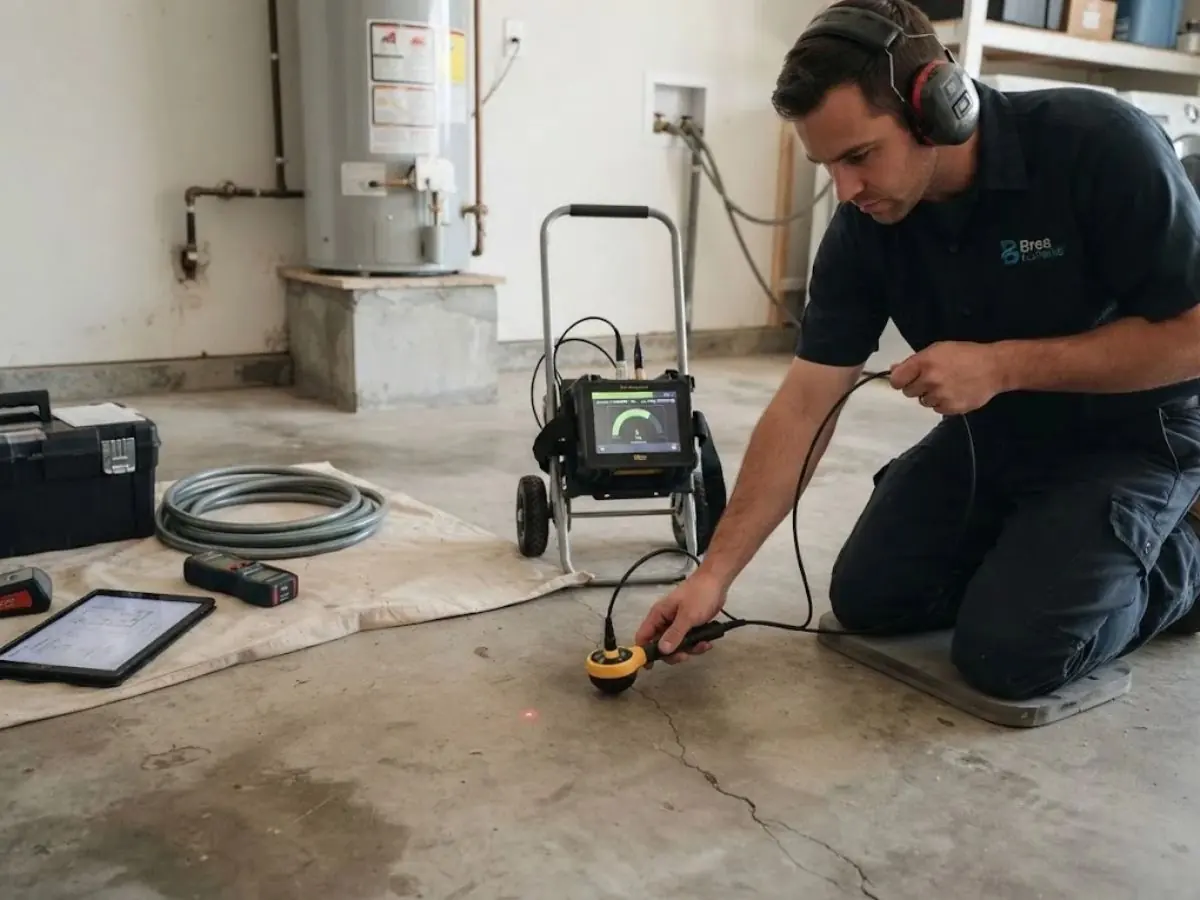
A slab leak is a leak in a pipe that runs under or through the concrete foundation of a house. The leak is hidden, so the first sign is often a bill that jumps or a floor that feels warm. Our line is open 24/7. If water is coming up through the floor, shut off the main valve and call.
This page matters only if your house is built on a concrete slab. Many houses have raised floors with a crawlspace instead, and their leaks are easier to reach. Ask the plumber which type you have, and we explain what it means for your repair.
Signs of a slab leak
A warm or hot spot on the floor
A leaking hot water line warms the concrete above it. Bare feet find it first.
Water on the floor with no source
Water seeping through the slab or along the baseboards points to a pressurized leak below.
The meter runs with everything off
Water is leaving the system, and a slab line is a common place.
Sound of running water
A faint hiss or trickle when everything is off suggests pressurized water escaping.
How a slab leak is found
Finding the leak is the hard part. We start by confirming it is on the supply side, with a meter test and by isolating sections of pipe. An electronic listening device then picks up the sound of escaping water through the concrete, and a locator marks the spot. Thermal imaging helps with hot water lines, and tracer methods help with stubborn cases.
Marking the spot lets us open a small section of the floor instead of a large one. That saves demolition and repair costs. See leak detection for how the same methods work in walls and ceilings.
Repair options: spot repair, reroute or repipe
| Option | How it works | Best when |
|---|---|---|
| Spot repair | Open the slab at the leak, cut out the bad pipe and splice in new | One isolated failure and the rest of the line is sound |
| Reroute | Abandon the leaking line and run new pipe through walls or attic | The pipe under the slab is failing in several places |
| Repipe | Replace the whole supply system with new pipe | The whole system shows corrosion. See repiping |
Rerouting avoids tearing up finished floors and puts the new pipe somewhere you can reach. It is often worth discussing even when spot repair is possible, since a pipe that has failed once is likely to fail again.
After detection: protecting the home
Shutting the water off reduces damage until the repair is done. Keep your insurer informed and keep photos. Many policies cover the damage from a sudden leak but not the cost of the pipe itself, and some cover the cost of reaching the leak. Your policy language decides.
Rohnert Park's water comes from Sonoma Water and local wells, and the city's Public Works at 707-588-3300 is the first call if your bill looks wrong. Ask about the meter while we check your plumbing, since a meter fault is a separate problem from a leak.
What affects the price
What to do before the plumber arrives
- Close the main water valve if you suspect a leak under the floor.
- Check floors for warm or damp spots, and keep electrical items away from wet areas.
- Note the meter reading, wait an hour with everything off, and tell dispatch what changed.
- Do not drill or cut into the floor yourself.
Standards for work under a slab
Work under a slab touches the structure, the plumbing and sometimes the permit process. Repairs are held to the California Plumbing Code, which is built on the Uniform Plumbing Code (UPC), and rerouting a line is a bigger scope than a spot repair. Ask the City Building Division at 707-588-2226 whether the plan needs a permit.
Questions we hear most
Do you handle slab leak emergencies at night or on weekends in Rohnert Park?
Yes. If water is coming up through the floor or a hot spot is growing, call the 24/7 line. Shut off the main valve first, and we dispatch a plumber to confirm and stop the leak.
How do I know my house is on a slab?
Houses on slabs have no crawlspace and the floor sits directly on concrete. If you can see a vent grate on the outside wall near the ground or there is a crawlspace door, you probably have a raised floor instead.
Will you have to break the floor?
Detection tools let us mark the leak and open a small section, not a large area. If the pipe is failing in several places, rerouting avoids the slab altogether.
Is a slab leak covered by insurance?
Policies vary. Many cover resulting water damage and sometimes the cost of access, but not the repair of the pipe itself. Call your agent early and keep the plumber's report.