
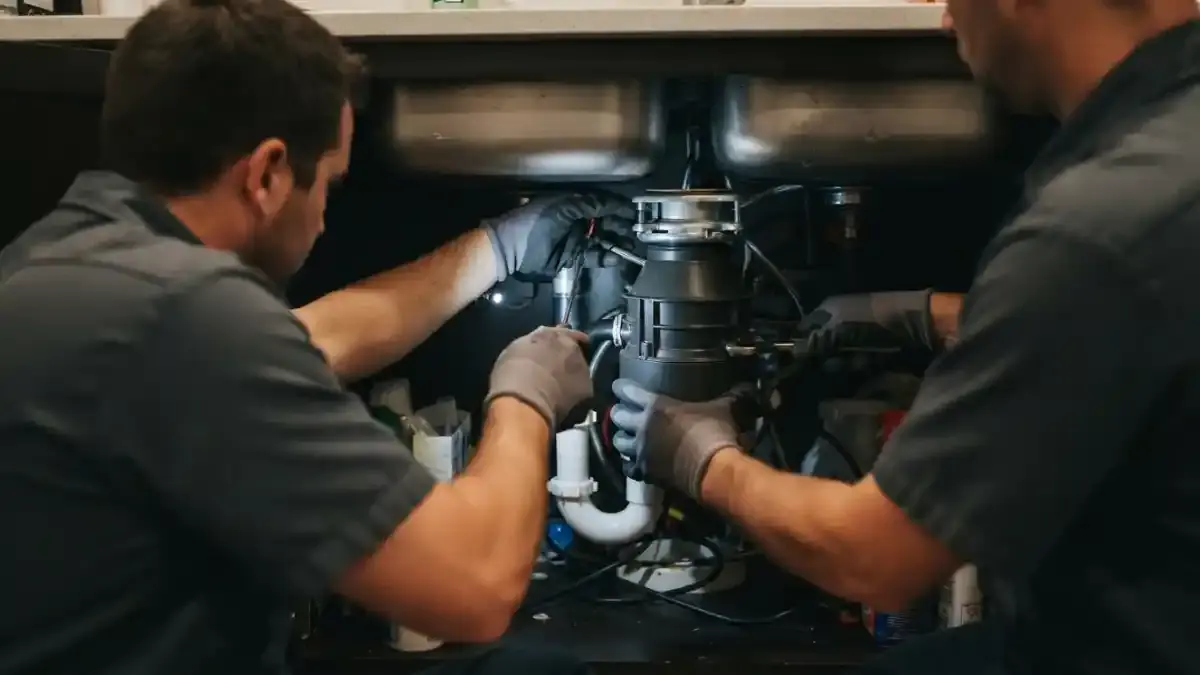
A leaking garbage disposal can soak the cabinet and floor quickly, and a dead one makes a kitchen hard to use. Our line is open 24/7 for leaks. While you wait, turn off the wall switch, shut the supply valves under the sink and put a bucket under the unit.
Most disposal problems fall into three groups: a jam, an electrical or motor fault, and a leak. Each has a different fix, and the first step in all of them is to turn the power off.
Humming, jammed or dead
A disposal that hums but does not spin is jammed. Turn off the switch, then use the hex socket at the bottom of the unit to free the blades, or an auger from above. Never put a hand into the opening. If it was freed and still will not spin, press the reset button on the bottom of the motor. A unit that is silent after reset may have a motor or wiring fault.
A disposal that trips a breaker or smells burnt is more serious, and we recommend a plumber and, where the wiring is at fault, an electrician. NEC rules apply to the outlet and switch, and we will tell you which part is which.
Where disposal leaks come from
Top flange or sink seal
The putty or gasket between the sink and the disposal has failed. Water appears at the top.
Side connections
The dishwasher inlet or the drain pipe has loosened or cracked.
Bottom of the unit
The housing has cracked or a seal has failed. The disposal usually needs replacement.
Drain trap
The slip joints on the trap are loose or the washers have worn out.
Repair or replace the disposal
Repair when
- The unit is relatively new
- The problem is a jam or a loose connection
- The leak is from a fitting or a seal
- The motor spins freely when reset
Replace when
- The housing is cracked or leaking at the bottom
- The motor has failed or smells burnt
- The unit is old and repairs are piling up
- You want a larger or quieter disposal
A replacement disposal is a short job when the sink mount is sound. A dishwasher drain connection, electrical hookup and a new flange are part of the work. If the disposal is the least of your sink problems and the whole drain is slow, a drain cleaning visit is the next step.
Kitchen sink backups and the disposal
A disposal does not clear a clogged drain, and a backed-up sink with a disposal usually has grease in the line. If water comes up in the second basin when the disposal runs, the line past the disposal is partly blocked. The fix is a cable, not a larger motor.
Keep grease, coffee grounds, fibrous vegetable scraps and large bones out of the disposal, and run cold water while it runs. Those habits save money more reliably than any repair.
What affects the price
For a leak that is coming from the supply under the sink, see faucet and sink repair. Insurance rarely covers a worn-out disposal, though it may help with water damage from a sudden leak.
What to do before the plumber arrives
- Switch the disposal off at the wall switch, then off at the breaker if you can reach it safely.
- Never put a hand into the disposal, even when it is off. Use tongs for anything you can see.
- Shut the supply valves under the sink if water is leaking.
- Leave the unit alone and call if it hums, smokes or trips the breaker.
Questions we hear most
Do you handle garbage disposal emergencies at night or on weekends in Rohnert Park?
Yes. If a disposal is leaking, tripping a breaker or flooding the cabinet, call the 24/7 line. Turn off the switch and shut the supply valves first.
Why is my garbage disposal humming but not working?
It is jammed. Turn off the power, free the blades with the hex socket underneath or an auger from above and press the reset button. If it still hums, the motor may be failing.
Can you reattach the dishwasher line to a new disposal?
Yes. A new disposal needs the dishwasher drain reconnected and the knockout plug removed, and we do both as part of a replacement.
How long does a disposal last?
It varies with use and quality, and many last a decade or more. A unit that jams repeatedly or leaks at the housing is near the end of its life.