
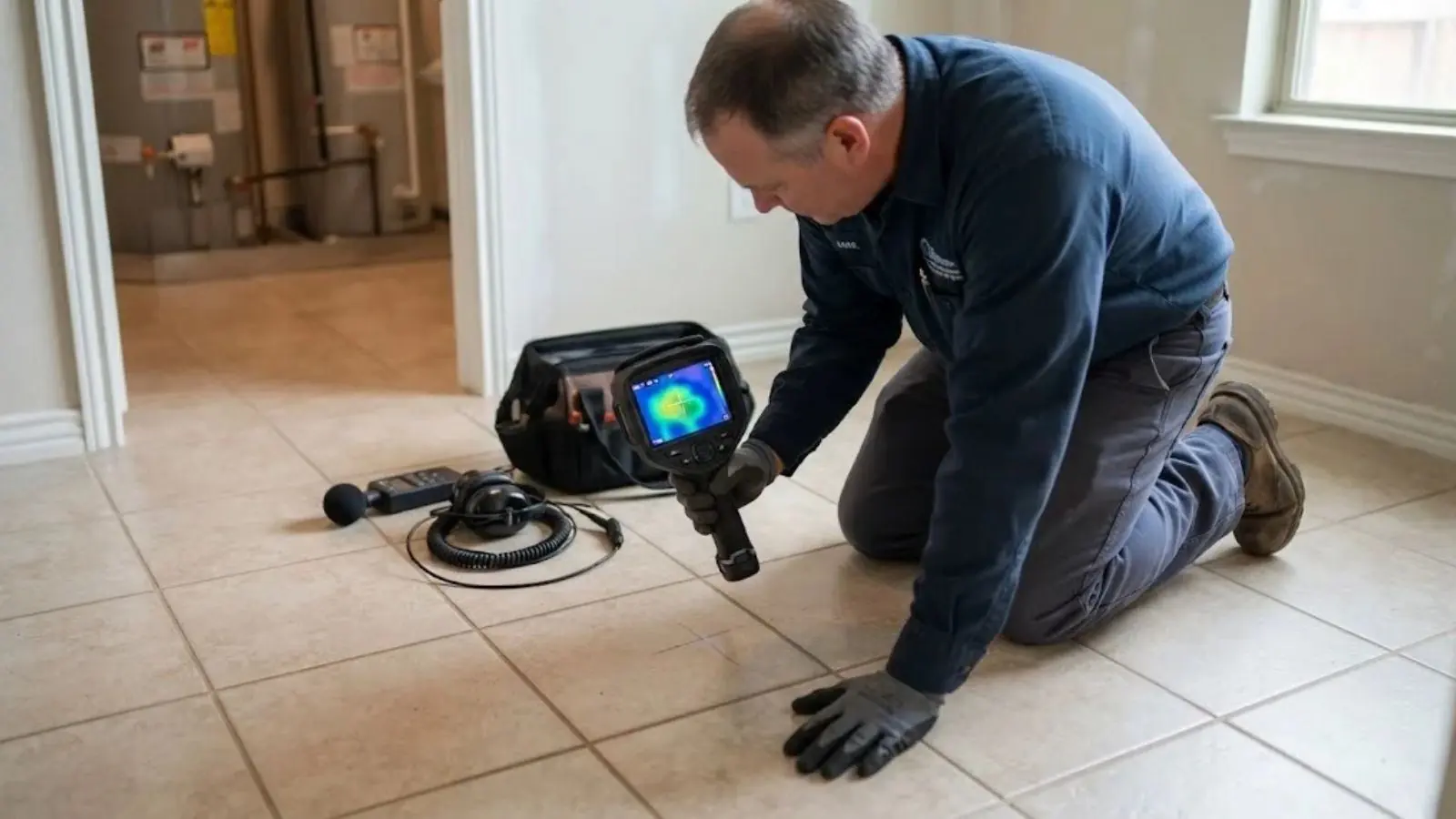
A leak you cannot see is still costing you money, and a leak inside a wall can ruin drywall and flooring before you notice. Our line is open 24/7 for active leaks. While you wait, close the main shutoff, which stops the water while we trace the source.
Leak detection is diagnostic work. Instead of cutting open walls and hoping, the plumber uses tools that find where water is escaping and then repairs only that spot. Most callers do not know what is wrong, only that something is.
Start with the symptom
The meter keeps moving
With every faucet and appliance off, the dial or digital flow indicator still turns. Water is leaving the system somewhere.
A high water bill with no new use
Usage jumped for a month with no change in habits. A running toilet, irrigation line or underground leak is likely.
Stains on a ceiling or wall
A brown ring or bubbling paint means water is traveling along framing, so the source may be several feet away.
Warm spots on a slab floor
A hot water line leaking under a slab can warm the concrete above it. See slab leak repair for what comes next.
Meter still running or a high water bill
To check yourself, turn off every fixture and look at the meter. Write down the reading, wait fifteen minutes with nothing running and look again. If the number changed, water is moving. Then close the house shutoff valve and check again. If the meter stops, the leak is inside the house. If it keeps running, the leak is on the line between the meter and the house, which is a water line repair job.
The City of Rohnert Park draws about 70 percent of its water from Sonoma Water and about 30 percent from local wells. If your bill spiked, call City Public Works at 707-588-3300 to ask about the meter while we check your plumbing.
Tools we use to find a hidden leak
- Acoustic listening to hear water escaping from a pressurized line through slab, soil or wall.
- Thermal imaging to show temperature differences where water is cooling or warming a surface.
- Moisture meters to map how far water has spread through drywall and framing.
- Pressure testing to isolate which section of pipe is losing water.
No tool is perfect and no honest plumber promises a pinpoint on the first pass every time. Combining two or three methods is what gets reliable results, and we explain what each one found.
Ceiling, wall, crawlspace and yard leaks
Water travels. A stain on a bedroom ceiling may come from a bathroom drain above it, a roof problem or a supply line in the attic. Leaks under the house show up as musty smells, sagging insulation and wet soil near the foundation. Irrigation lines and meter-box leaks in the yard add to the bill without ever showing inside the house. We check each possibility and tell you which one it was.
A falling pool or spa water level is a job for a pool specialist, so we keep our focus on the plumbing in and around the house. For leaks in a business, read commercial plumbing. When a pipe has already failed, see burst pipe repair.
What affects the price
Insurance may help with water damage from a sudden leak but often not with the cost of finding it. Ask your agent about your policy.
Standards once the leak is found
Finding a leak is a diagnostic step with no code of its own. Once the source is known, the repair is held to the California Plumbing Code, which is built on the Uniform Plumbing Code (UPC), and a written note of what was found and where is worth keeping for your insurer and for the next plumber.
Questions we hear most
Do you handle leak emergencies at night or on weekends in Rohnert Park?
Yes. If water is actively leaking into a wall, ceiling or floor, call the 24/7 line. Shut the main valve first, and we dispatch a plumber to trace and stop it.
How do I know if the leak is inside the house or on the line from the meter?
Turn off the house shutoff valve and watch the meter. If it stops moving, the leak is inside the house. If it keeps moving, the leak is between the meter and the house.
Do you have to cut into walls to find a leak?
Not at first. Acoustic and thermal tools locate most leaks from the surface, and we open the wall only at the confirmed spot, which keeps repairs small.
Why is my water bill so high when I see no leak?
Running toilets, irrigation lines, a failing water heater valve and underground leaks all add to a bill without leaving a visible puddle. The meter test tells you whether to look inside or outside.