
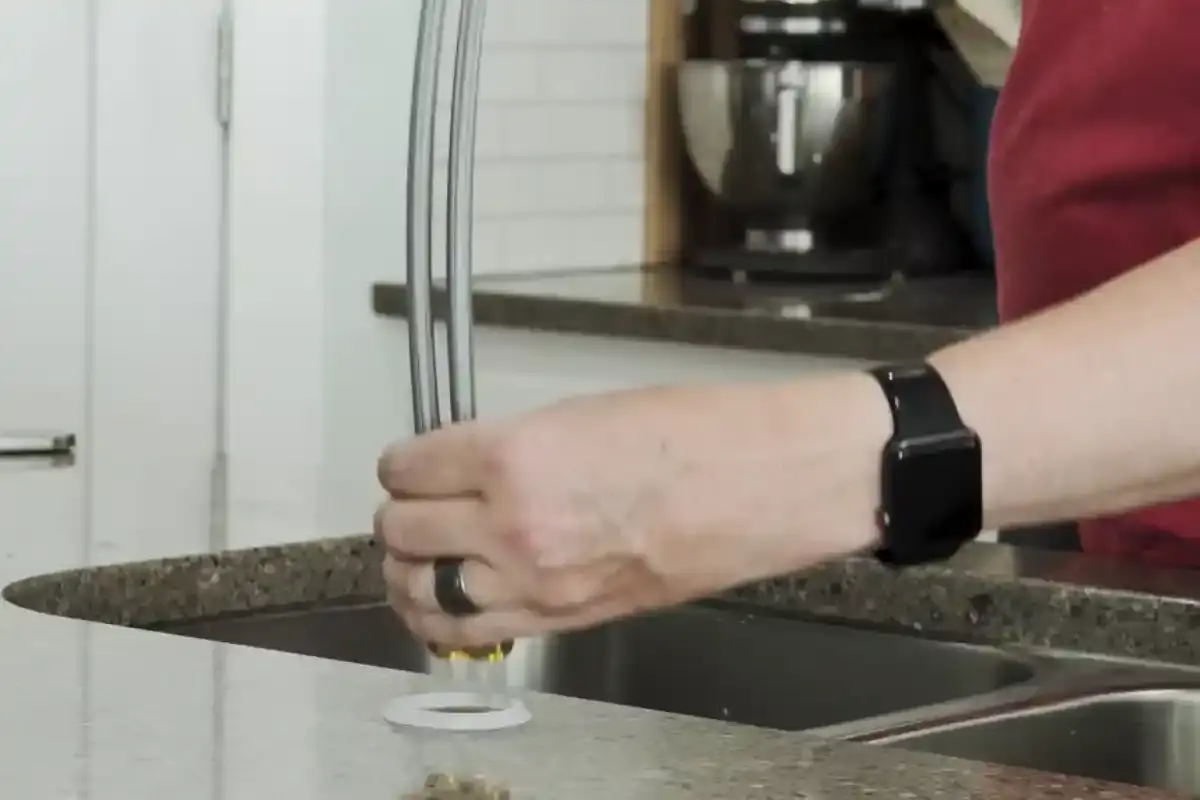
A kitchen faucet that rocks when you move the handle is annoying, and it is also a warning. Movement at the base stresses the connections underneath, and over time it can cause a slow leak inside the cabinet. Most loose faucets can be tightened in a few minutes, and the rest tell you something about what is wrong underneath.
This guide explains why faucets loosen, how to tighten one from under the sink and what to look for while you are there. It also covers the signs that a loose faucet is a symptom of a bigger problem.
Why faucets come loose
A faucet is held to the sink by mounting hardware under the deck, usually a nut or a pair of nuts on threaded shanks. Daily use gradually works that hardware loose. Hot water, soap and mineral buildup can also loosen a gasket or corrode the nut so that it no longer grips.
On some sinks the problem is the sink itself. A thin stainless steel basin can flex under the faucet, and a damaged countertop or a cracked mounting area cannot hold the hardware. If the faucet is tight but the sink moves with it, the faucet is not the fault.
How to tighten a loose faucet
- Clear the cabinet under the sink and put down a towel and a flashlight.
- Find the mounting nut or nuts on the underside of the faucet and the deck.
- Check whether a basin wrench or a faucet installer tool will reach them. A basin wrench is built for this tight space.
- Tighten the nut by hand and then snug it with the wrench. Do not apply great force, since you can crack a fitting or strip the threads.
- Hold the faucet straight from above while you tighten so it does not twist out of position.
- Check for movement and look for any water at the connections.
If the faucet has a separate sprayer or a pull-down hose, make sure the hose is not caught on the nut or pulling against it. A hose that is tight can lift one side of the faucet and look like a loose mount. Reroute it so it hangs freely, and check that the weight is on the faucet and not on the nut.
What to look for while you are under there
- Water drops on the supply lines or the shutoff valves.
- Stains, swelling or soft wood on the cabinet floor.
- Corrosion at the nuts, the shanks or the supply connections.
- A faucet base that has cracked or a mounting nut with stripped threads.
- A trap or drain pipe that has loosened.
A cabinet floor that is stained, soft or smells musty means water has been getting in for a while. Dry it, find the source and fix it, or the damage will spread to the cabinet and the flooring. A leak at the faucet is a faucet repair job. A leak from a pipe or valve below it may call for leak detection.
When tightening is not enough
| What you find | Likely cause | Next step |
|---|---|---|
| Faucet tightens and stays firm | Mounting hardware had worked loose | Done, recheck in a few weeks |
| Faucet keeps coming loose | Worn gasket, stripped nut or cracked base | Replace the worn part |
| Handle is loose, base is firm | Handle screw or cartridge wear | Tighten or replace the cartridge |
| Water at the base of the spout | Failed O-rings or a worn cartridge | Repair the faucet |
| Sink flexes as the faucet moves | Thin or damaged basin or counter | Contractor or plumber |
An old faucet that keeps loosening may simply be at the end of its life. Replacement is often a better answer than repeated repairs, particularly when parts are hard to find. Our plumbing installation page covers the work involved in a swap, and replacing the supply lines at the same time is sensible.
If the shutoff valves will not turn
If you have to shut off the water to work on the faucet and the valves under the sink will not close, stop. Do not force them. A valve that snaps leaves you with water running and no way to stop it except the main valve. A plumber can replace the shutoff valves and then do the faucet work with a dry cabinet.
Choosing a replacement faucet if yours is worn out
If a faucet is old, corroded or keeps loosening, replacing it can be easier than chasing parts. Start with the number of holes in the sink or the counter and the space available behind the faucet. A single-handle faucet needs one hole, and some designs cover extra holes with a deck plate. Measure the clearance under cabinets, since a tall pull-down faucet may hit a shelf.
Look at the construction too. Solid brass bodies and ceramic cartridges tend to last longer than lightweight plastic parts, and a faucet with a replaceable cartridge can be repaired later instead of replaced. Check that parts are available for the brand you choose, since a faucet that cannot be repaired becomes waste when a small seal wears out.
When you install the new faucet, use the new mounting hardware that comes with it and follow the torque guidance in the instructions. A faucet that is installed correctly the first time rarely comes loose.
Safety steps before you start
- Close the shutoff valves under the sink, or the main valve if they will not turn.
- Do not force a stuck valve, since the stem can snap.
- Keep electrical items away from the wet cabinet.
- Wear eye protection when you work overhead in a tight space.
Guidelines for a faucet mount
Faucets are mounted according to the manufacturer's installation guidelines, and the supply lines and drains below them are held to the California Plumbing Code, which is built on the Uniform Plumbing Code (UPC).
Rentals, university streets and older kitchens
The University District in K Section of Rohnert Park sits near Sonoma State University. If you rent in a unit like that, tell your landlord about a loose faucet before it becomes a leak, since a slow leak in a cabinet can turn into water damage in the unit below or next door.
In nearby Cotati, about a mile from the university, older kitchens are common. See Cotati and Penngrove for service in those areas.
Sources: City of Rohnert Park, City of Cotati.
Questions readers ask
Why does my kitchen faucet wobble?
The mounting nut under the sink has usually worked loose. A worn gasket, a stripped nut or a flexing sink can also cause it.
What tool do I need to tighten a faucet?
A basin wrench reaches the nuts in the tight space under the sink. An adjustable wrench or pliers can work if the nut is accessible.
Can a loose faucet cause a leak?
Yes. Movement stresses the connections under the sink and can cause a slow leak inside the cabinet that goes unnoticed.
Do you repair faucets in Rohnert Park the same day?
Same-day appointments are available when the schedule allows. If water is running and will not stop, call the 24/7 line.