
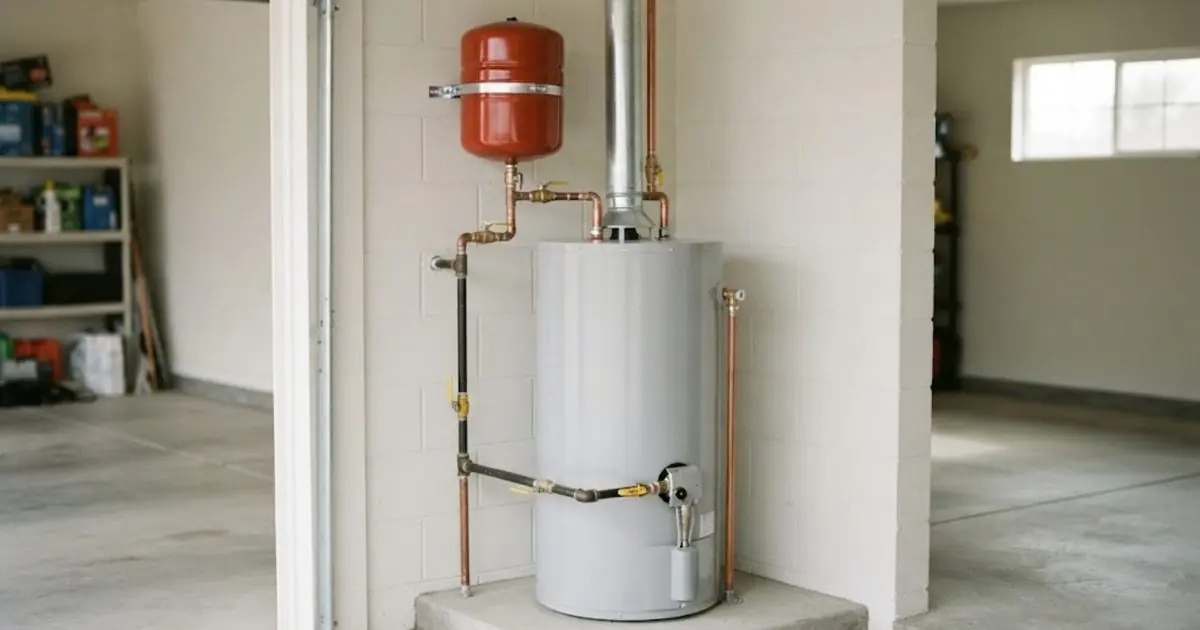
An expansion tank is the small tank, usually painted red or blue, that sits on the cold water line near a water heater. It is easy to ignore until it fails. When it does, the pressure relief valve may start dripping, the faucets may bang and the heater may be working under more stress than it should.
This guide explains what the tank does, how to tell whether it has failed and what is involved in replacing it. Replacing one is a job many plumbers do quickly, but it involves a pressurized tank, hot water and sometimes gas, so we explain what a homeowner can check and where to stop.
What an expansion tank does
Water expands when it is heated. In a home that has a check valve or a pressure reducing valve on the incoming line, the expanded water has nowhere to go, because it cannot flow back into the supply. The pressure in the plumbing system rises each time the heater runs. The expansion tank absorbs that extra volume in an air cushion and keeps the pressure steady.
Inside the tank, a rubber diaphragm or bladder separates the water side from an air side. The air side is charged to a set pressure, and it needs to match the pressure of the water in your house. Over the years the diaphragm can fail, the air can leak out, or the tank can corrode and begin to seep.
Signs an expansion tank has failed
Relief valve dripping
The pressure and temperature relief valve on the heater opens briefly each time pressure rises. A repeated drip can mean thermal expansion is not being absorbed.
Banging pipes
Water hammer or knocking when a fixture shuts off can be a sign of pressure spikes.
Water at the air valve
Press the small valve stem on top of the tank. If water comes out, the diaphragm has failed and the tank is waterlogged.
A heavy, dull tank
Tap the tank. The top should sound hollow and the bottom solid. If the whole tank sounds solid, it is full of water.
Rust or seepage
Corrosion at the connection or a wet tank body means the shell has failed.
What a homeowner can check
With the heater running normally, look at the tank and its connection for moisture. Check the pressure and temperature relief valve and the discharge pipe for drips or staining. A pressure gauge screwed onto a hose bib will show the house water pressure, and this number matters because the tank must be set to match it.
Do not open the relief valve repeatedly or cap its discharge pipe. That valve is a safety device. If it is discharging, the heater is telling you that pressure or temperature is too high, and it needs a plumber, not a workaround. Our water heater repair page explains the checks we make.
What a safe replacement involves
- Turn off the power or the gas to the water heater, and shut the cold supply.
- Relieve pressure by opening a hot tap and, if needed, the tank's drain.
- Disconnect the old tank and check the fitting and the pipe for corrosion.
- Match the new tank size to the heater capacity and the house pressure, using the manufacturer's sizing guidance.
- Set the air charge on the new tank to the house water pressure before it is connected.
- Support the tank, since a full tank is heavy, and seal the fittings with the right tape or compound.
- Restore water, bleed the air from the lines, check for leaks and confirm pressure.
Step five is the one that is often missed. A new tank arrives charged to a factory setting, and that may not match your home. If the air charge is wrong, the new tank will not protect the system properly, and the problem returns. A plumber will check the charge with a gauge before installing it.
Should you replace the tank or the heater
An expansion tank is a modest part, and replacing it is often the right fix. If the heater itself is old, leaking at the base or failing in other ways, it may make more sense to replace the whole system at once. A new heater install is also the right time to add a tank, since many installations call for one. Our water heater replacement page explains how to weigh the two.
If you are not sure whether your home needs a tank at all, ask. Whether one is required depends on your plumbing, the heater and the local rules. The City of Rohnert Park Building Division at 707-588-2226 can answer permit questions, and a plumber can tell you what your system needs.
Sizing and setting the new tank
Expansion tanks come in several sizes, and the right one depends on the capacity of the water heater, the incoming water pressure and the temperature the heater is set to. Manufacturers publish sizing charts that match these numbers, and a plumber uses them. A tank that is too small cannot absorb the expansion, and the pressure keeps climbing.
Mounting matters too. Some tanks hang from the pipe and some stand on a bracket, and a full tank is heavy enough to strain a fitting that is not supported. If the old tank has been hanging from a copper line and the line has bent or the fitting is weeping, replace the support as well as the tank.
Once the new tank is in, check the pressure at a hose bib over the next few days. If the number stays steady and the relief valve stays dry, the tank is doing its job. If the pressure still creeps up, the cause may be a pressure reducing valve that is failing, and that is a separate repair.
Safety steps before you start
- Turn off the power or gas to the heater before touching anything.
- Close the cold supply and relieve pressure through a hot tap.
- Let the water cool, since the tank and pipes can scald.
- If you smell gas, leave the building and call the gas utility or 911 first.
Standards for the tank
Expansion tanks are installed according to the manufacturer's guidelines, and the plumbing around them is held to the California Plumbing Code, which is built on the Uniform Plumbing Code (UPC). Sizing charts from the manufacturer are the reference, not a rule of thumb.
Pressure in a city that buys its water
The City of Rohnert Park gets about 70 percent of its water from Sonoma Water, mostly from the Russian River, and about 30 percent from local wells, moved through seven storage tanks. Pressure at your tap comes from that system, so the pressure you measure is the number your tank should be set to.
If you are in a nearby town, your water may come from a different provider. Sebastopol, for example, runs its own water and sewer service, so ask your provider. See Sebastopol and Petaluma for those service areas.
Source: City of Rohnert Park Public Works, City of Sebastopol.
Questions readers ask
How do I know if my expansion tank is bad?
Press the air valve on top. If water comes out, the diaphragm has failed. A relief valve that drips repeatedly and banging pipes are other signs.
Can I replace an expansion tank myself?
It involves a pressurized tank, hot water and possibly gas, so we recommend a plumber. If you do try, shut off power or gas first and charge the new tank to your house pressure.
What pressure should the tank be set to?
It should match your home's water pressure, which you can measure with a gauge on a hose bib. Check the tank label and the manufacturer's instructions.
Is a leaking relief valve an emergency?
It can be. A relief valve that discharges is releasing pressure or heat for a reason. Call a plumber, and do not cap the discharge pipe.