
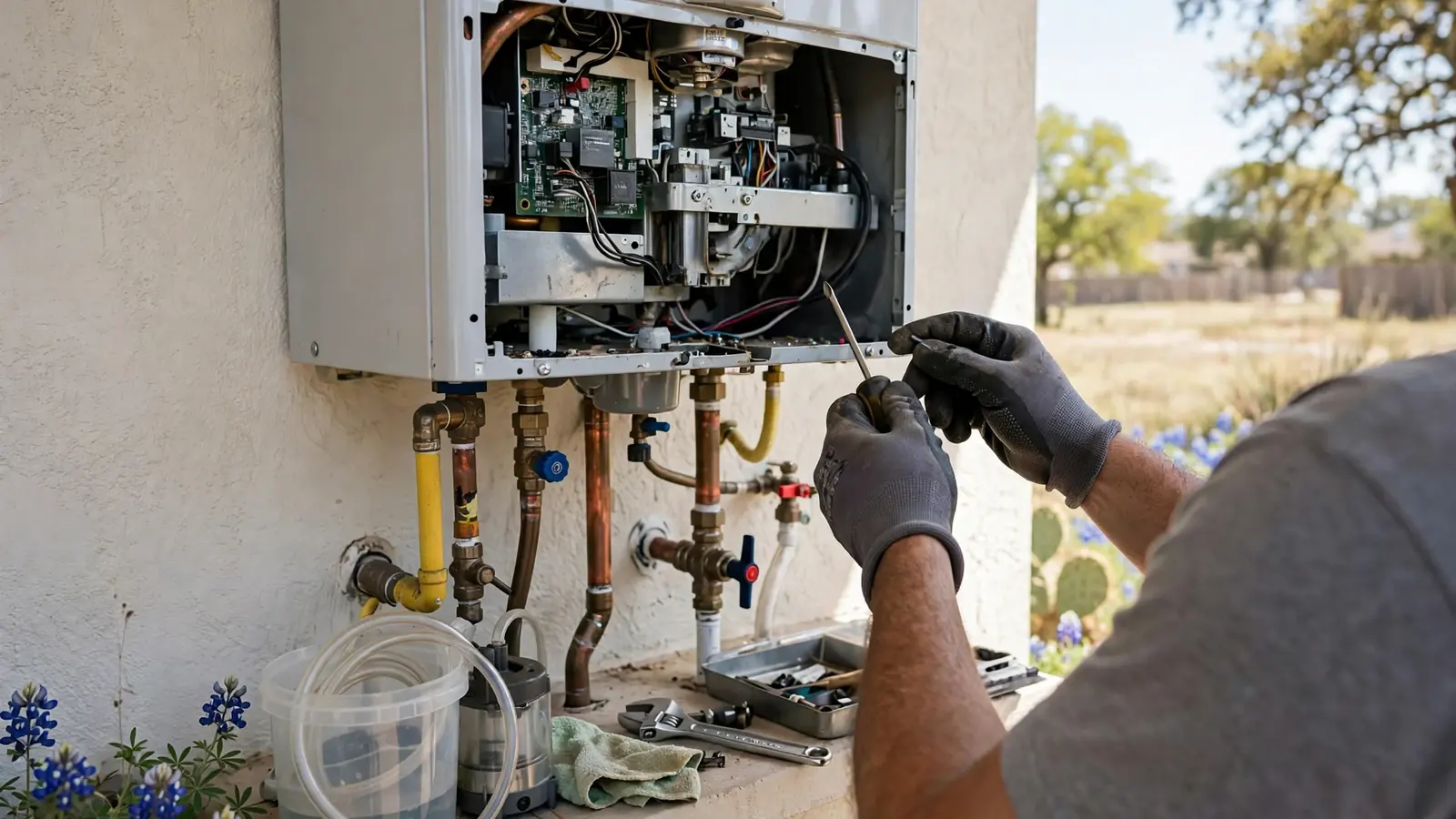
A puddle under a tankless water heater is a smaller problem than a puddle under a tank, because there is no forty or fifty gallons waiting to come out at once. It is still a problem worth stopping. Water on or near a gas appliance and its vent, and on the electronics inside the cabinet, can turn a cheap fix into an expensive one if it keeps running.
This guide walks through where tankless leaks usually come from, what a homeowner can safely check, and the signs that mean the unit should be shut off and looked at by a plumber. It is general guidance. Every model is different, so the installation manual for your unit always has the final word.
First, stop the water and the fuel
If water is actively running from the unit, close the cold water supply valve on the line feeding it. Most tankless installations have a pair of service valves on the water lines at the bottom, and closing the cold one stops the flow. Then turn the unit off at its power switch or breaker.
If you smell gas at any point, do not stop to troubleshoot. Leave the building and call the gas utility or 911 from outside. A gas smell and a water leak together is a reason to get out first and call us second.
Where tankless leaks usually come from
Water line connections
The fittings where the hot and cold lines meet the unit can loosen over time or seep at a worn washer. Water that appears at the bottom edge of the cabinet often starts here.
Service valves and isolation valves
Valves used for flushing the unit can weep at the stem or at the hose connections after a service visit.
Pressure relief valve and drain line
A relief valve that drips is releasing pressure for a reason. A steady drip can point to a pressure or thermal expansion problem in the house.
Condensate drain
High-efficiency units make acidic condensate that drains through a small line. A blocked or cracked condensate line can leak or overflow.
Heat exchanger
Scale or corrosion can eventually open a pinhole inside the unit. That leak is not a fitting problem and the repair is a major one.
What you can safely check
With the power off and the cold valve closed, look at the underside of the unit and the connections with a flashlight and a dry paper towel. Wipe each fitting and watch which one gets wet first. A leak that starts at a connection usually shows up in minutes, while a leak from the unit itself may seep from a seam or from behind a panel.
Look at the condensate line too. If it is kinked, disconnected or full of debris, water can back up and look like a leak from the unit. A clear plastic line that holds standing water is a hint. Do not remove the front cover unless the manual says a homeowner may, since there are electrical parts and gas components inside.
When to stop and call a plumber
- Water is coming from inside the cabinet or from behind the front panel.
- The pressure relief valve is dripping or discharging.
- There is a gas smell, a flame that looks wrong or an error code that will not clear.
- The unit has scale buildup, rust-colored water or a history of skipped flushing.
- You are not sure where the water is coming from.
Some tankless leaks are fitting repairs and some mean the unit has reached the end of its useful life. A plumber can tell the difference by testing the connections, the valves and the heat exchanger. Our tankless water heater service page explains what we look at, and if the unit is beyond repair the water heater replacement page covers the options.
How flushing prevents the next leak
Hard water leaves scale inside a tankless heat exchanger, and scale makes the unit work harder and run hotter. Many manufacturers recommend periodic flushing with the service valves, using a pump and a descaling solution. The schedule depends on your water and on the model, so check the manual rather than relying on a number you read online.
If you are unsure how hard your water is, test your tap or ask your water provider for its latest quality report. In Rohnert Park the City publishes a water quality report each year, and the City says its water meets state and federal standards. A softener or a scale filter is a separate decision, covered on our water softener and filtration page.
What a repair visit looks like
A plumber starts by finding the leak with the unit off and the water supply closed. Connections get dried and checked one at a time, the relief valve and its discharge line get inspected, and the condensate line is traced to its drain. If the leak comes from a fitting, the repair is usually a new washer, a new valve or a retightened connection, and the unit is back in service the same visit.
If the leak is inside the unit, the conversation changes. A cracked heat exchanger is not a field repair on most models, and the question becomes whether the unit is worth replacing in kind or whether a different heater suits the house better. A good plumber lays out both paths, with the reasons, before any work starts. Ask how old the unit is, what the manufacturer's warranty covers and whether the leak is likely to come back.
Keep the manual and the date of the last flush handy when you call. The more the plumber knows about the model and its history, the faster the diagnosis goes.
Water in Rohnert Park
The City of Rohnert Park draws about 70 percent of its water from Sonoma Water, mostly from the Russian River, and about 30 percent from local wells. That mix is one reason to read the annual report before you decide how to protect a tankless heater from scale.
If you rent or own in the lettered sections east of Highway 101, near Sonoma State, ask your landlord or HOA where the unit's service valves are before you need them. For homes in nearby towns, see Cotati and Petaluma.
Source: City of Rohnert Park Public Works.
Questions readers ask
Is a leaking tankless water heater dangerous?
It can be. Water near the electrical parts and the vent is a hazard, and a gas smell means leave the building and call the gas utility or 911 first. Shut off the cold supply and the power, then call a plumber.
Why is my tankless heater dripping from the bottom?
The usual causes are a loose water connection, a weeping service valve, a clogged condensate line or a pressure relief valve that is discharging. The source decides whether it is a small repair.
Does a tankless unit need to be flushed?
Many manufacturers recommend it, especially in areas with hard water. Follow the schedule in your manual, since it varies by model.
Do you work on tankless heaters in Rohnert Park at night?
Yes. Our emergency line is open 24/7, and a leaking heater is a reasonable reason to call. Shut off the cold supply and the power first.